How to Upload a File Using Python
File uploading is an essential utility every developer should know. Various software applications require uploading files to exercise sure operations. Several desktops and web applications demand uploading files from the customer or the users in the course of a regular file (e.g., an audio file, an epitome file, text file, etc.) Most uploading of files refers to applications that apply the internet.
Python supports different libraries that simplify data transfer over HTTP. There are three different packages that developers can use to upload a file in a python program.
Uploading Files through a Python program:
There are various means of uploading files through a python program. Some might require the support of HTML script and buttons while others tin straight upload files through the program itself.
Method 1: Using the Python's os Module:
In this method, we have to use the HTML code to set specific actions. HTML caters to a variety of attributes for different HTML elements. We accept to use the <form> along with the activity aspect to gear up the Python program for execution. As well, the enctype aspect with "multi-role/form-information" value volition help the HTML grade to upload a file. Lastly, we need the input tag with the filename attribute to upload the file we want.
Here is our HTML code:
<html> <body> Uploading file by executing a Python script <form enctype = "multipart/grade-data" action = "upload_script.py" method = "mail"> <br> File Uploading <input type = "file" name = "filename" /> <p> <input type = "submit" value = "Upload Now" /> </p> </class> </body> </html> Lastly, we demand the input tag with the filename attribute to upload the file we want. The bone module in Python allows the Python programme to interact with the system. As our file resides as a part of our operating organization, we demand to use the os module in our Python plan.
Python code [upload_script.py]:
import os fi = form['filename'] if fi.filename: # This code will strip the leading absolute path from your file-name fil = os.path.basename(fi.filename) # open for reading & writing the file into the server open(fn, 'wb').write(fi.file.read()) Caption:
Here, nosotros have start imported the OS module so that nosotros can deal with the operating system related operations. Next, nosotros have to create an identifier that will hold the filename for uploading. Now, using the if condition, we have to cheque whether the file name exists or not.
If yes, nosotros will apply the os.path.basename() to excerpt the filename by striping the leading absolute path from the file. We volition then employ another identifier to store that path. Now, we can open the file for reading and writing it into the server.
Method 2: Using the Requests library:
The requests module contains many predefined methods that allow developers to ship HTTP requests using Python. The HTTP request delivers a response object containing response data such as encoding, content, status, etc. Using this, yous do not need to manually suspend query strings for the URLs or any other form-encoding for the PUT & Postal service information. Since it is not a congenital-in library, nosotros take to install it using the pip.
$ pip install requests Now, y'all tin create the Python file and import the requests into your program.
import requests dfile = open up("datafile.txt", "rb") url = "http://httpbin.org/post" test_res = requests.post(url, files = {"form_field_name": dfile}) if test_res.ok: print(" File uploaded successfully ! ") impress(test_res.text) else: print(" Please Upload again ! ") Explanation:
This technique uses the requests library and for using information technology, we have to import it in our Python programme. And then, nosotros will open our file (datafile.txt) in read binary mode. Next, ascertain a string identifier that stores the URL. And then, we have to call the postal service() method and pass the URL and the opened file (as a Python dictionary).
Now, nosotros will check whether test_res (exam result) is Ok or not. If It is OK, then we will print a success bulletin along with the resultant text. Otherwise, nosotros will prompt the user to upload information technology again.
Method 3: Using Filestack API:
We can likewise use the Python SDK and call the filestack API (Application Programming Interface) to upload files through the Python plan. To obtain this SDK, you lot need to install it using the PIP control.
pip install filestack-python In one case you lot have installed the filestack SDK, you accept to begin it with your Python program. Then yous have to create an case of the Client using the Filestack API primal. This Customer will perform the heavy operations for you in this plan.
Program
from filestack import Client c = Client("API'southward Key") filelnk = c.upload(filepath = '/path/of/file.png') impress(filelnk.url) Make sure y'all replace the "API'due south Primal" with the actual API key you generate before writing the program.
Explanation:
Filestack API requires importing in our Python Program. In one case we import the Customer module from the filestack, nosotros will provide the API key (the ane we volition receive at the time of registration). Shop it in a dissever variable. Next, connect to the file link that you want to upload and set the file path every bit athe statement value in the upload() method. Finally, display the filelnk file.
Uploading Multiple Files in Python:
Now, since you have got a basic understanding of how to deal with uploading a single file in Python, let us now motion to a new topic – uploading multiple files in Python. Hither, we will utilize the Python script to fetch the file from your system. In this department, y'all will use the requests library.
Program:
import requests testUrl = "http://httpbin.org/mail service" testFiles = { "test_file_1": open up("file1.txt", "rb"), "test_file_2": open up("file2.txt", "rb"), "test_file_3": open("file3.txt", "rb") } responseVar = requests.post(testUrl, files = testFiles) if responseVar.ok: print("Successfully Uploaded all files !") print(responseVar.text) else: print("Upload failed !") Output:
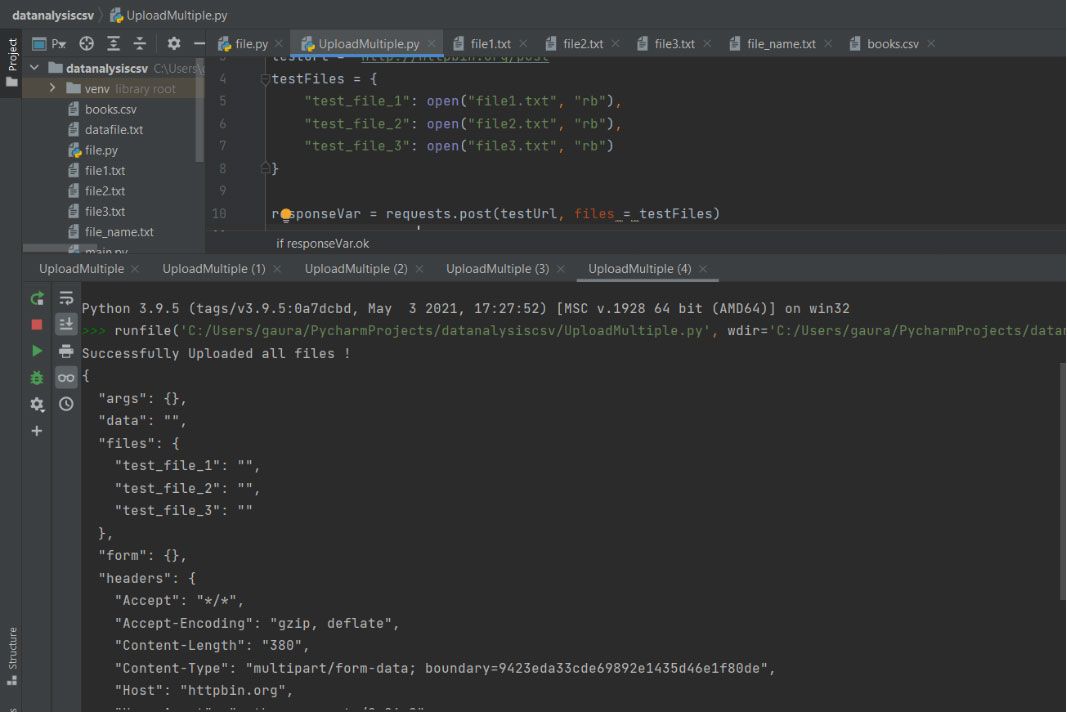
Caption:
Hither, we will commencement import the requests module. And so, we will use the testUrl variable to put the mail service HTTP asking. Then we volition create a lexicon past the name testFiles that volition have three central-value pairs where the keys volition be the file-id and values are the file names.
And then nosotros volition execute the mail service request method that will have ii parameters, the testUrl and the files that will concord multiple filenames and store the entire render value in the responseVar. Then, we volition bank check whether the responseVar is executing smoothly or not.
If aye, then a success message volition be displayed using the print() forth with the responseVar.text(). Otherwise, it will return an mistake or failure message using the impress(). In this technique, y'all simply have to name the files in the dictionary value to upload them all at once.
Determination:
Among all these methods, API calls (third method) take the maximum fourth dimension and hence the least efficient. The showtime technique is explicitly used in spider web awarding evolution and the 2nd technique is used in desktop or stand up-alone awarding development. The Os module is faster as compared to the requests library because it uses frequent arrangement calls and is closer to machine. Just for file uploading purpose, the request module is easy to use.
williamsforneirdis1961.blogspot.com
Source: https://www.stechies.com/upload-files-python/#:~:text=import%20requests%20dfile%20%3D%20open(%22,print(%22%20File%20uploaded%20successfully%20!

Post a Comment for "How to Upload a File Using Python"