Teachings Agains Homosexuality in the Bible
There are a number of passages in the Hebrew Bible and the New Attestation that have been interpreted equally involving aforementioned-sex activity sexual acts, desires, and relationships.[1] [2] [3] The passages about homosexual individuals and sexual relations in the Hebrew Bible are found primarily in the Torah[i] (the offset five books traditionally attributed to Moses).[4] Some texts included in the New Testament besides reference homosexual individuals and sexual relations, such as the Gospel of Matthew, the Gospel of Luke, and various letters attributed to the Campaigner Paul originally directed to the early Christian churches in Asia Pocket-size.[1] Both references in the Hebrew Bible and the New Attestation have been interpreted as referring primarily to male homosexual individuals and sexual practices.[1]
Hebrew Bible [edit]
The Hebrew Bible/Quondam Testament and its traditional interpretations in Judaism and Christianity have historically affirmed and endorsed a patriarchal and heteronormative approach towards human being sexuality,[5] [6] favouring exclusively penetrative vaginal intercourse betwixt men and women within the boundaries of marriage over all other forms of human sexual activity,[5] [6] including autoeroticism, masturbation, oral sex, non-penetrative and non-heterosexual sexual intercourse (all of which have been labeled as "sodomy" at various times),[seven] believing and didactics that such behaviors are forbidden because they're considered sinful,[v] [6] and further compared to or derived from the beliefs of the alleged residents of Sodom and Gomorrah.[1] [5] [viii] [9] [10]
Leviticus 18 and 20 [edit]
Chapters xviii and 20 of Leviticus course part of the Holiness code and listing prohibited forms of intercourse, including the following verses:
- "You shall non lie with a male person equally with a adult female; it is an anathema." Chapter 18 poesy 22[11]
- "If a man lies with a male person as with a woman, both of them have committed an abomination; they shall surely be put to death; their blood is upon them." Chapter 20 verse 13[12]
These two verses take historically been interpreted by Jews and Christians as clear overall prohibitions against homosexual acts in general.[ citation needed ] More than recent interpretations focus on the passage's context as function of the Holiness Code, a code of purity meant to distinguish the behavior of the Israelites from the polytheistic Canaanites.[13] One of those interpretations is from Janet Edmonds, which says:
To interpret these passages of Leviticus, it'southward of import to know that this volume of the Bible focuses on ritual purity for the Israelites, and setting guidelines for the Israelites to distinguish themselves from their heathen neighbors, the Egyptians and Canaanites, who lived in the lands before they were settled by the Jews. This is shown in Leviticus Capacity xviii and 20 by three specific scripture passages (Leviticus 18:2–iii, 18:24 and xx:23) that state that the Israelites should never exercise what the Egyptians and Canaanites did.[fourteen]
Analyses by Saul Olyan, Professor of Religious Studies and Director of the Judaic Studies Programme at Brown University, Grand. Renato Lings, and others focus on ambiguities embedded in the original Hebrew, arguing these ambiguities may non prohibit all erotic expression between men but rather proscribe incest between male family members.[15] [sixteen] They argue English language translators of Leviticus added to the original text to compensate for perceived lacunae in the biblical text; but thereby contradistinct the poesy's meaning. Leviticus xviii:22 reads:
| w'eth-zäkhār lö' tiškav miškevē 'iššâ | And with a male person you shall not lie the lying downs of a woman.[a] |
The NRSV renders Leviticus eighteen:22 as "You shall not lie with a male as with a woman".
Lings argues the inclusion of prepositions not in the original text and the translation of Leviticus' otherwise unattested miškevē within the context of Genesis (i.e., miškevē is found only within Leviticus 18:22 and xx:13, and Genesis 49:four) is crucial to illuminate the incestuous connotation of the passage, and the translation of miškevē in low-cal of Genesis results in the text of Leviticus 18 and 20 becoming more than cohesive.[16]
Sodom and Gomorrah [edit]

The Destruction of Sodom and Gomorrah, John Martin, 1852
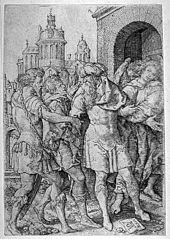
The story of the destruction of Sodom and Gomorrah in Genesis does not explicitly identify homosexuality as the sin for which they were destroyed. Some interpreters find the story of Sodom and a like one in Judges 19 to condemn the tearing rape of guests more than homosexuality,[17] but the passage has historically been interpreted inside Judaism and Christianity equally a punishment for homosexuality due to the interpretation that the men of Sodom wished to rape, or accept sex with, the angels who retrieved Lot.[17]
While the Jewish prophets spoke only of lack of charity equally the sin of Sodom,[18] the exclusively sexual interpretation became and then prevalent among Christian communities that the proper noun "Sodom" became the basis of the give-and-take "sodomy", nevertheless a legal synonym for homosexual and non-procreative sexual acts, particularly anal or oral sex.[xix]
While the Jewish prophets Isaiah, Jeremiah, Amos and Zephaniah refer vaguely to the sin of Sodom,[18] Ezekiel specifies that the city was destroyed because of its commission of social injustice as well equally its commission of "abomination:"[17]
Behold, this was the iniquity of thy sister Sodom, pride, fullness of staff of life, and abundance of idleness was in her and in her daughters, neither did she strengthen the hand of the poor and needy. And they were haughty, and committed abomination before me: therefore I took them away as I saw practiced.[20]
The Talmudic tradition as written between c. 370–500 also interprets the sin of Sodom as lack of charity, with the attempted rape of the angels being a manifestation of the city's violation of the social order of hospitality.[21]
Later traditions on Sodom's sin, such equally Testaments of the Twelve Patriarchs, considered information technology to be an illicit course of heterosexual intercourse.[22] In Jude ane:seven–8 the Bible says of Sodom and Gomorrha:
Even equally Sodom and Gomorrha, and the cities about them in similar manner, giving themselves over to fornication, and going after strange flesh, are set forth an case, suffering the vengeance of eternal fire. Likewise besides these filthy dreamers defile the mankind..."[23]
This has been interpreted every bit a reference to homosexuality by some and to the sexual lust of mortals later on angels by others.[17] Jewish writers Philo (d. Advert fifty) and Josephus (37 –c. 100) were the outset reported individuals to affirm unambiguously that homosexuality was among the sins of Sodom.[22] By the cease of the 1st century Advertizement, Jews commonly identified the sin of Sodom with homosexual practices.[24]
David and Jonathan, Ruth and Naomi [edit]
The account of David and Jonathan in the Books of Samuel has been interpreted by traditional and mainstream writers every bit a human relationship of affectionate regard. Information technology has besides been interpreted past some authors as of a sexual nature.[25] [26] Theologian Theodore Jennings identifies the story every bit one of desire for David by both Saul and Jonathan, stating, "Saul'south jealousy has driven [David] into Jonathan's artillery."[27] Michael Coogan, lecturer on the Old Attestation at Harvard Divinity School, addresses the claim of the declared homosexual relationship betwixt David and Jonathan and explicitly rejects it.[28]
The story of Ruth and Naomi is besides occasionally interpreted by contemporary scholars as the story of a lesbian couple.[29] [30] Coogan states that the Hebrew Bible does not even mention lesbianism.[31]
New Testament [edit]
Romans i:26–27 [edit]
Romans 1:26–27 is commonly cited every bit one instance of New Attestation teaching against homosexuality:
That is why God abandoned them to their shameful desires. Even the women turned confronting the natural way to have sexual practice and instead indulged in sex with each other. And the men, instead of having normal sexual relations with women, burned with lust for each other. Men did shameful things with other men, and as a result of this sin, they suffered within themselves the penalty they deserved.[32]
This passage, office of a larger discourse in 1:eighteen–32, has been debated by contemporary Bible scholars equally to its relevance today, what it actually prohibits and whether it represents Paul's view or rhetoric that Paul is actively arguing against. Clement of Alexandria and John Chrysostom regarded information technology as concerning female and male homosexual intercourse, while Augustine of Hippo viewed it equally referring to heterosexual and homosexual anal sex activity.[33] Although Christians of several denominations have historically maintained that this verse is a complete prohibition of all forms of homosexual activity,[34] some 20th- and 21st-century authors contend the passage is non a blanket condemnation of homosexual acts, suggesting, among other interpretations, that the passage condemned heterosexuals who experimented with homosexual activity[18] [35] or that Paul's condemnation was relative to his own culture, in which homosexuality was not understood as an orientation and in which existence penetrated was seen as shameful.[35] These interpretations are, however, in a minority.[18] [35]
Scholars, noting that Romans ane:eighteen–32 represents an exception in the volume of Romans equally a whole and uses vocabulary elsewhere not seen in Paul's messages, have for decades puzzled over the passage.[36] [37] Some scholars believe these verses are part of a much larger non-Pauline interpolation, a later improver to the letter.[38] Others argue that the grammer of the Greek original demands that Romans 1:18–32 be read as a rhetorical set up-up, a summary of Hellenistic Jewish legalist rhetoric that Paul actively forbids followers of Christ from using in Romans 2.[39] [40] [41]
1 Corinthians 6:9–11; one Timothy one:viii–11 [edit]
In the context of the broader immorality of his audience, Paul the Apostle wrote in the First Epistle to the Corinthians, chapter vi verses 9-11:
Know ye not that the unrighteous shall not inherit the kingdom of God? Exist not deceived: neither fornicators, nor idolaters, nor adulterers, nor effeminate ( malakos ), nor abusers of themselves with mankind ( arsenokoitai ), Nor thieves, nor covetous, nor drunkards, nor revilers, nor extortioners, shall inherit the kingdom of God. And such were some of you: only ye are washed, only ye are sanctified, just ye are justified in the proper name of the Lord Jesus, and by the Spirit of our God.[42]
1 Timothy 1:8–11 states:
Just we know that the police force is good, if a human use information technology lawfully; Knowing this, that the police is not fabricated for a righteous man, but for the lawless and ill-behaved, for the ungodly and for sinners, for unholy and profane, for murderers of fathers and murderers of mothers, for manslayers; For whoremongers, for them that defile themselves with mankind ( arsenokoitai ), for menstealers, for liars, for perjured persons, and if in that location be whatsoever other thing that is opposite to sound doctrine; Co-ordinate to the glorious gospel of the blest God, which was committed to my trust.[43]
In the letter to the Corinthians, within the list of people who will non inherit the kingdom of God, Paul uses ii Greek words: malakia ( μαλακοὶ ) and arsenokoitai ( ἀρσενοκοῖται ).
Arsenokoitai is a compound word. Chemical compound words are formed when ii or more words are put together to form a new discussion with a new significant. In this case, arsenokoitai is from the Greek words arrhēn / arsēn ( ἄῤῥην/ἄρσην ) pregnant "boy", and koitēn ( κοίτην ) significant "bed", with a sexual connotation.[44] A direct translation would be "male-bed". Its start recorded utilize was by Paul in 1 Corinthians and later on in 1 Timothy 1 (attributed to Paul), and remains unattested in contemporaneous sources. Some scholars consider Paul to have adapted this give-and-take past translating, to Greek, the poetry from Leviticus 20:13, with additional adaption from the wording of the Septuagint translations of Leviticus 18:22 and 20:23[45] Due to its unclear definition, English translators struggled with representing the concept of arsenokoitai . It has been variously rendered as "sexual perverts" (RSV), "sodomites" (NRSV), "abusers of themselves with flesh" (KJV), "men who accept sex with men" (NIV) or "practicing homosexuals" (NET).
Malakia ( μαλακία , "softness", "weakliness")[46] is an ancient Greek discussion that, in relation to men, has sometimes been translated every bit "effeminacy". Also translates to "of things subject to impact, "soft" (used in Matthew xi:8 and Luke 7:25 to describe a garment); of things non subject to touch, "gentle"; and, of persons or modes of life, a number of meanings that include "pathic".[47] However, in modern Greek it has come up to mean "masturbation", and its derivative μαλάκας – malakas means "one who masturbates".
Interpretation [edit]
Bishop Gene Robinson says the early church seemed to have understood information technology as a person with a "soft" or weak morality; later, it would come to denote (and be translated as) those who engage in masturbation, or "those who corruption themselves"; all that is factually known almost the word is that it ways "soft".[48] [ better source needed ]
Almost scholars hold that Paul had 2 passages of the Volume of Leviticus – Leviticus 18:22 and Leviticus 20:13[49] – in mind when he used the word ἀρσενοκοῖται (which may be of his coinage),[17] with most commentators and translators interpreting it equally a reference to male person same-sex intercourse.[50] However, John Boswell states that it "did not connote homosexuality to Paul or his early readers", and that in later Christian literature the discussion is used, for instance, by Aristides of Athens (c. 138) conspicuously not for homosexuality and possibly for prostitution, Eusebius (d. c. 340) who evidently used information technology in reference to women, and in the writings of sixth-century Patriarch John IV of Constantinople, known as John the Faster. In a passage dealing with sexual misconduct, John speaks of arsenokoitia as active or passive and says that "many men even commit the sin of arsenokoitia with their wives".[b] Although the constituent elements of the chemical compound word refer to sleeping with men, he manifestly does not utilise it to mean homosexual intercourse and appears to employ it for anal intercourse, not generic homosexual activity.[52] Particulars of Boswell's arguments are rejected by several scholars in a way qualified every bit persuasive past David F. Greenberg, who declares usage of the term arsenokoites past writers such every bit Aristides of Athens and Eusebius, and in the Sibylline Oracles, to be "consequent with a homosexual meaning".[53] A discussion document issued by the Firm of Bishops of the Church of England states that well-nigh scholars still hold that the word arsenokoites relates to homosexuality.[54] Another work attributed to John the Faster, a series of canons that for diverse sins provided shorter though stricter penances in place of the previous longer penances, applies a penance of 80 days for "intercourse of men with one another" (catechism 9), explained in the Pedalion equally mutual masturbation – double the penalty for solitary masturbation (canon 8) – and three years with xerophagy or, in accord with the older catechism of Basil the Great, xv without (catechism 18) for being "then mad as to copulate with some other man" – ἀρρενομανήσαντα in the original – explained in the Pedalion as "guilty of arsenocoetia (i.e., sexual intercourse between males)" – ἀρσενοκοίτην in the original. According to the same piece of work, ordination is not to be conferred on someone who as a boy has been the victim of anal intercourse, but this is non the instance if the semen was ejaculated between his thighs (canon 19). These canons are included, with commentary, in the Pedalion, the most widely used collection of canons of the Greek Orthodox Church,[55] an English translation of which was produced past Denver Cummings and published past the Orthodox Christian Educational Society in 1957 under the championship The Rudder.[56] [57] [58]
Some scholars consider that the term was not used to refer to a homosexual orientation, only argue that it referred instead to sex activity.[59] [60]
Other scholars have interpreted arsenokoitai and malakoi (some other word that appears in 1 Corinthians 6:ix}[61] as referring to weakness and effeminacy or to the practice of exploitative pederasty.[62] [63]
Jesus's discussion of marriage [edit]
In Matthew xix and parallel in Mark 10, Jesus is asked if a man can divorce his married woman. In that context, Jesus replies:
He answered, "Have you non read that the 1 who made them at the beginning 'made them male person and female',[64] and said, 'For this reason a human being shall go out his male parent and female parent and be joined to his wife, and the two shall go one flesh'?[65] So they are no longer two, simply 1 flesh. Therefore what God has joined together, permit no one split."
—Matthew 19:4–half-dozen (NRSV)[66]
Theologian Robert A. J. Gagnon argues that Jesus'due south back-to-back references to Genesis 1 and Genesis 2 show that he "presupposed a two-sexual activity requirement for marriage".[67] On the other mitt, Bart Ehrman, Professor of Religious Studies at the University of N Carolina, states of Jesus's references to Genesis i and 2, "[Jesus is] not really defining marriage. He's answering a specific question." Ehrman notes farther "And here the conversation is quite easy. In our surviving records Jesus says nothing about aforementioned-sex acts or sexual orientation. Nothing. Nada."[68]
Matthew 8; Luke vii [edit]
In Matthew 8:v–13 and Luke 7:1–10, Jesus heals a centurion's servant who is dying. Daniel A. Helminiak writes that the Greek discussion pais , used in this account to refer to the servant, was sometimes given a sexual pregnant.[69] Donald Wold states that its normal pregnant is "boy", "child" or "slave" and its awarding to a male child lover escapes notice in the standard lexica of Liddell and Scott and Bauer.[seventy] The Greek-English language Lexicon of Liddell and Scott registers three meanings of the word παῖς ( pais ): a child in relation to descent (son or daughter); a kid in relation to age (boy or daughter); a slave or servant (male or female person). In her detailed written report of the episode in Matthew and Luke, Wendy Cotter dismisses every bit very unlikely the idea that the employ of the Greek word pais indicated a sexual human relationship between the centurion and the young slave.[71]
Matthew'south account has parallels in Luke seven:1–x and John 4:46–53. There are major differences between John'south account and those of the ii synoptic writers, but such differences be likewise between the 2 synoptic accounts, with adjacent to goose egg of the details in Luke seven:2–half dozen being nowadays also in Matthew.[72] The Commentary of Craig A. Evans states that the word pais used by Matthew may exist that used in the hypothetical source known as Q used by both Matthew and Luke and, since information technology can mean either son or slave, it became doulos (slave) in Luke and huios (son) in John.[72] Writers who acknowledge John iv:46–53 every bit a parallel passage by and large interpret Matthew's pais as "child" or "boy", while those who exclude it run across it as significant "servant" or "slave".[73]
Theodore W. Jennings Jr. and Tat-Siong Benny Liew write that Roman historical data about patron-client relationships and nearly same-sex relations among soldiers support the view that the pais in Matthew's account is the centurion'southward "boy-love", and that the centurion did not want Jesus to enter his business firm for fright the boy would be enamoured of Jesus instead.[74] D.B. Saddington writes that, while he does not exclude the possibility, the evidence the two put forrad supports "neither of these interpretations",[75] with Wendy Cotter saying that they fail to have account of Jewish condemnation of pederasty.[71]
Matthew 19:12 [edit]
In Matthew 19:12, Jesus speaks of eunuchs who were born as such, eunuchs who were fabricated so by others, and eunuchs who choose to live as such for the kingdom of heaven.[76] Jesus's reference to eunuchs who were built-in as such has been interpreted by some commentators every bit having to do with homosexual orientation; Clement of Alexandria, for instance, cites in his book "Stromata" (chapter Iii,1,1)[77] an earlier interpretation from Basilides that some men, from birth, are naturally averse to women and should not marry.[78] "The start category – those eunuchs who have been and then from birth – is the closest description we have in the Bible of what nosotros sympathise today as homosexual."[79]
Acts 8 [edit]
The Ethiopian eunuch, an early Gentile catechumen described in Acts 8, has been interpreted by some commentators as an early gay Christian, based on the fact that the discussion "eunuch" in the Bible was non e'er used literally, every bit in Matthew 19:12.[79] [80] Some religious commentators advise that the combination of "eunuch" together with the title "court official" indicates a literal eunuch who would have been excluded from the Temple by the brake in Deuteronomy 23:ane.[81] [82]
See also [edit]
- Abomination (Judaism)
- Biblical constabulary
- Christianity and homosexuality
- Homosexuality and Judaism
- Homosexuality and organized religion
- Homosexuality in ancient Greece
- Malakia
- Sexuality of Jesus
- Women in Christianity
Notes [edit]
- ^ formal equivalence, offered past Olyan[15]
- ^ Original Greek: "Τὸ μέντοι τῆς ἀρσενοκοιτίας μῦσος πολλοὶ καὶ μετὰ τῶν γυναικῶν αὐτῶν ἐκτελοῦσιν" [51]
References [edit]
- ^ a b c d e Gnuse, Robert Chiliad. (May 2015). "Seven Gay Texts: Biblical Passages Used to Condemn Homosexuality". Biblical Theology Bulletin. SAGE Publications on behalf of Biblical Theology Bulletin Inc. 45 (two): 68–87. doi:10.1177/0146107915577097. ISSN 1945-7596. S2CID 170127256.
- ^ Frontain, Raymond-Jean (2003). "Introduction". In Frontain, Raymond-Jean (ed.). Reclaiming the Sacred: The Bible in Gay and Lesbian Civilization (2nd ed.). New York and London: Harrington Park Press. pp. 1–24. ISBN9781560233558. LCCN 2002068889.
- ^ Palmer, Randall; Winner, Lauren F. (2005) [2002]. "Protestants and Homosexuality". Protestantism in America. Columbia Gimmicky American Religion Serial. New York: Columbia University Press. pp. 149–178. ISBN9780231111317. LCCN 2002023859.
- ^ Dever, William G. (2001). "Getting at the "History behind the History"". What Did the Biblical Writers Know and When Did They Know Information technology?: What Archeology Can Tell Us About the Reality of Ancient State of israel. Grand Rapids, Michigan and Cambridge, U.G.: Wm. B. Eerdmans. pp. 97–102. ISBN978-0-8028-2126-three. OCLC 46394298.
- ^ a b c d Mbuwayesango, Dora R. (2016) [2015]. "Part Three: The Bible and Bodies – Sex and Sexuality in Biblical Narrative". In Fewell, Danna N. (ed.). The Oxford Handbook of Biblical Narrative. Oxford and New York: Oxford University Printing. pp. 456–465. doi:10.1093/oxfordhb/9780199967728.013.39. ISBN9780199967728. LCCN 2015033360. S2CID 146505567.
- ^ a b c Leeming, David A. (June 2003). Carey, Lindsay B. (ed.). "Religion and Sexuality: The Perversion of a Natural Matrimony". Periodical of Religion and Wellness. Springer Verlag. 42 (two): 101–109. doi:ten.1023/A:1023621612061. ISSN 1573-6571. JSTOR 27511667. S2CID 38974409.
- ^ Sauer, Michelle M. (2015). "The Unexpected Actuality: "Deviance" and Transgression". Gender in Medieval Culture. London: Bloomsbury Academic. pp. 74–78. doi:10.5040/9781474210683.ch-003. ISBN978-1-4411-2160-8.
- ^ Gilbert, Kathleen (29 September 2008). "Bishop Soto tells NACDLGM: 'Homosexuality is Sinful'". Catholic Online. Archived from the original on xxx September 2008.
- ^ Robinson, Gene; Krehely, Jeff; Steenland, Sally (8 December 2010). "What are Religious Texts Actually Proverb about Gay and Transgender Rights?". Center for American Progress . Retrieved 30 March 2021.
- ^ Modisane, Cameron (fifteen November 2014). "The Story of Sodom and Gomorrah was NOT About Homosexuality". News24 . Retrieved xxx March 2021.
- ^ Leviticus 18:22 Bible Gateway provides 42 other English translations of the poetry.
- ^ Leviticus 20:13. Bible Gateway provides 42 other English translations of the verse.
- ^ Coogan 2010, p. 135 The Hebrew Bible but prohibits this exercise for men. This is clearly seen by contrasting these verses with Lev. 18:23 and xx:15-sixteen respectively, where sex with animals is prohibited for both men and women. More than recent interpretations focus on its context every bit part of the Holiness Code, a code of purity meant to distinguish the behavior of the Israelites from the Canaanites. Siker, Jeffrey S. (2007). Homosexuality and Faith. Greenwood Publishing Group. p. 67. ISBN978-0-313-33088-ix.
- ^ Edmonds, Janet (2016). "The Bible Doesn't Say Homosexuality Is A Sin" (PDF). Rm Network.
- ^ a b Olyan, Saul (Oct 1994). "'And with a male you shall not prevarication the lying down of a woman': on the meaning and significance of Leviticus xviii:22 and 20:13". Journal of the History of Sexuality. five (2): 179–206. PMID 11639358.
- ^ a b Lings, G. Renato (11 August 2009). "The 'Lyings' of a Adult female: Male-Male Incest in Leviticus 18.22?". Theology & Sexuality. fifteen (2): 231–250. doi:10.1558/tse.v15i2.231. S2CID 170582258.
- ^ a b c d e Powell, Mark Allan (2011). HarperCollins Bible Dictionary. HarperCollins. ISBN978-0-06-207859-9.
- ^ a b c d Crompton, Louis (2006). Homosexuality & Civilization. Harvard University Press. pp. 37–39. ISBN9780674030060.
- ^ "Merriam-Webster Online Dictionary". Merriam-Webster . Retrieved 22 November 2012.
- ^ Ezekiel xvi:49–l
- ^ Loader, J. A. (1990). J.A. Loader, A Tale of Two Cities: Sodom and Gomorrah in the Former Attestation, Early Jewish and Early Christian Traditions . ISBN9789024253333 . Retrieved ten Apr 2013.
- ^ a b Greenberg, David F. (1990). The Construction of Homosexuality. University of Chicago Press. p. 201. ISBN978-0-226-30628-5.
- ^ Jude i:seven
- ^ Ellins, J. Harold (2006). Sex in the Bible. Greenwood Publishing. p. 117. ISBN0-275-98767-1.
- ^ Boswell, John. Same-sex Unions in Premodern Europe. New York: Vintage, 1994. (pp. 135–137)
- ^ Halperin, David M. 1 Hundred Years of Homosexuality. New York: Routledge, 1990. (p. 83)
- ^ Jennings, Theodore (2005). Jacob'due south Wound: Homoerotic Narrative in the Literature of Ancient Israel. Continuum. pp. 13–36. ISBN9780826417121.
- ^ Coogan 2010, p. 121.
- ^ Havrelock, Rachel (27 Oct 2011). River Hashemite kingdom of jordan: The Mythology of a Dividing Line. Academy of Chicago Press. p. 61. ISBN978-0-226-31959-9.
Contemporary exegetes accept perceived lesbian undertones in the human relationship between Ruth and Naomi.38 38. See Rebecca Alpert, "Finding Our By: A Lesbian Interpretation of the Book of Ruth," Reading Ruth: Gimmicky Women Reclaim a Sacred Story, ed. Judith A. Kates and Gail Twersky Reimer (New York: Ballatine Books, 1994). Lesleigh Cushing Stahlberg calls the book of Ruth "the prooftext the religious left needs for sanctioning forbidden marriages." Stahlberg, "Mod Day Moabites: The Bible and the Contend Almost Same-Sex Matrimony," Biblical Interpretation 16 (2008): 474.
- ^ Longman III, Tremper; Enns, Peter (6 June 2008). Dictionary of the Old Attestation: Wisdom, Poesy & Writings: A Compendium of Contemporary Biblical Scholarship. InterVarsity Press. p. 699. ISBN978-0-8308-1783-2.
Amongst feminist authors perceptions of the volume's bulletin and value have varied widely, with some seeing the story as a model for lesbian relationships (Alpert), and others every bit a celebration of the relationship between two strong and resourceful women (Brenner 1983).
- ^ Coogan 2010, p. 135.
- ^ Romans 1:26–27
- ^ Bernadette J. Brooten: Patristic Interpretations of Romans one:26, in: Elizabeth East. Livingstone (ed.), Studia Patristica 18, vol. one, Kalamazoo 1985, p. 287-291.
- ^ Hertzog, Marking (1996). The lavender vote: Lesbians, gay men, and bisexuals in American electoral politics. NYU Press. p. 58. ISBN0-8147-3530-4.
- ^ a b c Kruse, Colin (2012). Paul Letter to the Romans. Wm. B. Eerdmans Publishing Co. p. 111. ISBN9780802837431.
- ^ Massing, Michael (2018). Fatal Discord: Erasmus, Luther, and the Fight for the Western Mind. Harper. ISBN9780060517601.
- ^ O'Neill, J. C. (1975). Paul's Letter to the Romans. Penguin.
- ^ Percy Neale Harrison, Paulines and Pastorals (London: Villiers Publications, 1964), 80–85; Robert Martyr Hawkins, The Recovery of the Historical Paul (Nashville, TN: Vanderbilt University Press, 1943), 79–86; Alfred Firmin Loisy, The Origins of the New Testament (New Hyde Park, NY: University Books, 1962), 250; ibid., The Birth of the Christian Religion (New Hyde Park, NY: Academy Books, 1962), 363 due north.21; Winsome Munro, Authority in Paul and Peter: The Identification of a Pastoral Stratum in the Pauline Corpus and 1 Peter, SNTSMS 45 (Cambridge: Cambridge University Printing, 1983), 113; John C. O'Neill, Paul'due south Letter to the Romans (Harmondsworth: Penguin Books, 1975), 40–56; William O. Walker, Jr., "Romans 1.18–2.29: A Non-Pauline Interpolation?" New Testament Studies 45, no. 4 (1999): 533–52.
- ^ McKnight, Scot (2019). Reading Romans Backward. Baylor University Press.
- ^ Porter, Calvin (1994). "Romans 1:18–32: Its Role in Developing the Argument". New Attestation Studies. 40: 210–228. doi:x.1017/S0028688500020567.
- ^ Martin, Colby (2016). Unclobber. Westminster John Knox Printing. ISBN9780664262211.
- ^ i Corinthians half-dozen:9
- ^ 1 Timothy 1:ten
- ^ Pregeant, Russell (2008). Stefan Koenemann & Ronald A. Jenner (ed.). Knowing truth, doing good: engaging New Testament ethics. Fortress Press. p. 252. ISBN978-0-8006-3846-vii.
- ^ Greenberg, David (1990). The Construction of Homosexuality . Chicago: University of Chicago Press. ISBN0-226-30628-3.
- ^ "Malakia Meaning in Bible – New Testament Greek Lexicon – New American Standard". Bible Study Tools . Retrieved 2 July 2020.
- ^ "Henry George Liddell, Robert Scott, A Greek-English Dictionary, entry μαλακός". Perseus.tufts.edu. Retrieved 11 March 2014.
- ^ Robinson 2012
- ^ Leviticus xviii:22; Leviticus twenty:xiii
- ^ Bromiley, Geoffrey Due west. (1995). The International Standard Bible Encyclopedia. Vol. Q–Z. Eerdmans. p. 437. ISBN978-0-8028-3784-iv.
- ^ Migne PG 88, col. 1896.
- ^ Boswell, John (1981). Christianity, social tolerance, and homosexuality: gay people in Western Europe from the beginning of the Christian era to the fourteenth century. Academy of Chicago Printing. ISBN978-0-226-06711-vii.
- ^ Greenberg, David F. (1990). The Construction of Homosexuality. Academy of Chicago Press. pp. 213–214. ISBN978-0-226-30628-five.
- ^ Some Issues in Human Sexuality: A Guide to the Contend. Church building Firm Publishing. 2003. pp. 137, 139. ISBN978-0-7151-3868-7.
- ^ Doe, Norman (12 September 2013). Christian Law: Contemporary Principles. Cambridge University Printing. p. 20. ISBN978-ane-107-00692-8.
These are contained in several collections; the about widely used today in Greek-speaking Orthodoxy is the Pedalion. 60 60 The Rudder (Pedalion) of the Orthodox Christians or All the Sacred and Divine Canons, ed. C. Cummings (Orthodox Christian Educational Order, Chicago, Illinois, 1957), from the metaphor of the church building as a ship, 'the members of the Church building [are] guided on their voyage through life past ways of the holy canons'.
- ^ "Cummings translation, pp. 1678–1697" (PDF). Archived from the original (PDF) on five November 2013.
- ^ "Canons of the Holy Fathers". holytrinitymission.org.
- ^ Text in the original Greek linguistic communication, pp. 562–578
- ^ Siker, Jeffrey S. (2007). Homosexuality and Faith. Greenwood. p. 70. ISBN978-0-313-33088-9.
- ^ Dunn, James D.G. (2006). The Theology of Paul the Apostle. Eerdmans. pp. 121–122. ISBN978-0-8028-4423-1.
- ^ 1 Corinthians 6:9
- ^ Scroggs, Robin (1983). The New Attestation and homosexuality: contextual background for gimmicky fence. Fortress Press. pp. 62–65, 106–109. ISBN978-0-8006-1854-4.
- ^ Berlinerblau, Jacques (2005). The secular Bible: why nonbelievers must take religion seriously. Cambridge University Press. p. 108. ISBN978-0-521-85314-9.
- ^ Genesis 1:27
- ^ Genesis 2:24
- ^ Matthew 19:4–19:6
- ^ Robert A. J. Gagnon, "Why the Disagreement over the Biblical Witness on Homosexual Do?: A Response to David M. Myers and Letha Dawson Scanzoni, What God Has Joined Together?" Reformed Review 59.1 (Autumn 2005): 19–130, 56. Bachelor online at
- ^ Ehrman, Bart (15 November 2019). "Jesus and Homosexuality". The Bart Ehrman Blog.
- ^ Helminiak, Daniel A. (2012). Sex and the Sacred. Routledge. p. 192. ISBN978-1-136-57075-9.
- ^ Moore, Stephen D. (2001). God'south Beauty Parlor. Stanford University Press. p. 257. ISBN978-0-8047-4332-seven.
- ^ a b Cotter, Wendy (2010). The Christ of the Miracle Stories. Bakery Academic. p. 125. ISBN978-0-8010-3950-8.
- ^ a b Evans, Craig A., ed. (2003). The Bible Knowledge Commentary: Matthew-Luke. David C. Melt. p. 169. ISBN978-0-7814-3868-i.
- ^ Voorwinde, Stephen (2011). Jesus' Emotions in the Gospels. Continuum. p. 18. ISBN978-0-567-43061-8 . Retrieved 11 March 2014.
- ^ Jennings, Theodore W.; Liew, Tat-Siong Benny (2004). "Mistaken Identities but Model Organized religion: Rereading the Centurion, the Chap, and the Christ in Matthew eight:5–xiii". Journal of Biblical Literature. 123 (3): 467–494. doi:ten.2307/3268043. JSTOR 3268043.
- ^ Saddington, D. B. (2006). "The Centurion in Matthew eight:5–xiii: Consideration of the Proposal of Theodore W. Jennings, Jr., and Tat-Siong Benny Liew". Journal of Biblical Literature. 125 (ane): 140–142. doi:10.2307/27638351. JSTOR 27638351.
- ^ Matthew 19:12
- ^ Clemente de Alejandria: Stromata II-III, Fuentes Patristicas, vol.x (Marcelo Merino Rodriguez ed.), Madrid 1998, p. 315
- ^ DeYoung, James B. Homosexuality (DeYoung). Kregel Academic. p. 333. ISBN978-0-8254-9588-5.
- ^ a b McNeill, John J. (1993). The Church and the homosexual (4 ed.). Buoy Press. pp. 64–65. ISBN9780807079317.
- ^ McNeill, John J. (2010). Freedom, Glorious Liberty: The Spiritual Journey to the Fullness of Life for Gays, Lesbians, and Everybody Else. Lethe. p. 211. ISBN9781590211489.
- ^ MacArthur, John (1994). New Testament Commentary, Book 6: Acts 1–12. Moody. p. 254. ISBN0-8024-0759-v.
- ^ Johnson, Luke T.; Harrington, Daniel J. (1992). The Acts of the Apostles. Liturgical Printing. p. 155. ISBN0-8146-5807-5.
Bibliography [edit]
- Amsel, Nachum. Homosexuality in Orthodox Judaism Archived 8 August 2017 at the Wayback Machine.
- Boswell, John. 1980 Christianity, Social Tolerance and Homosexuality. Academy of Chicago Printing. ISBN 0-226-06711-four
- Brooten, Bernadette. 1998 Beloved Betwixt Women: Early on Christian Responses to Female Homoeroticism University of Chicago Press. ISBN 0-226-07592-3
- Chocolate-brown, Driver, Briggs and Gesenius. Hebrew Lexicon entry for Dabaq. The One-time Testament Hebrew Lexicon.
- Brunson, Hal. 2007 Lesbos, Narcissus, and Paulos: Homosexual Myth and Christian Truth. ISBN 0-595-40596-7
- Coogan, Michael (2010). God and Sex. What the Bible Really Says (1st ed.). New York, Boston: Twelve. Hachette Volume Group. ISBN978-0-446-54525-nine. OCLC 505927356.
- Crompton, Louis, et al. 2003 Homosexuality and Civilization. The Belknap Printing of Harvard University Printing ISBN 0-674-01197-10
- Dover, Kenneth (1978). Greek Homosexuality. Harvard University Press. ISBN0-674-36270-5.
- Durns, John Barclay (2002). "Lot'south Wife Looked Dorsum" (PDF). four. Journal of Religion and Society: 1–16. Archived from the original (PDF) on 27 February 2006.
- Elliott, John H. 2004 "No kingdom of God for softies? or, what was Paul actually maxim? 1 Corinthians half-dozen:ix–10 in context'" Biblical Theology Bulletin, Spring 2004.
- Gagnon, Robert A. J. 2001 The Bible and Homosexual Practice. Abingdon Press. ISBN 0-687-08413-X
- Greenberg, David F. 1988 The construction of homosexuality. Academy of Chicago Printing. ISBN 0-226-30628-iii
- Halsall, Paul. Homosexuality and Catholicism: A Partially Annotated Bibliography
- Helminiak, Daniel 2000 What the Bible really says about homosexuality. Alamo Square Press. ISBN 1-886360-09-X
- Horner, Tom. 1978 Jonathan Loved David. Westminster Press. ISBN 0-664-24185-nine
- House of Bishops 1991 Issues in Homo Sexuality. Church of England. ISBN 0-7151-3745-X
- Jennings, Theodore 2003 The Man Jesus Loved: Homoerotic Narratives From the New Testament. Pilgrim Press. ISBN 0-8298-1535-X
- Johns, Loren 2004 "Homosexuality and the Bible: A Case Study in the Apply of the Bible for Ideals" Associated Mennonite Biblical Seminary.
- Koch, Timothy R 2001 "Cruising as methodology: homoeroticism and the scriptures", in Queer Commentary and the Hebrew Bible, Ken Stone, ed. Pilgrim Printing. ISBN 0-8298-1447-7
- Martin, Dale. 1996 "Arsenokoites and malakos: Meanings and Consequences", pp. 117–136. in Biblical Ideals and Homosexuality. Robert Brawley, ed. Westminster Press ISBN 0-664-25638-4.
- McNeill, J. J. 1993 The Church and the Homosexual. Beacon Press. (fourth edn.). ISBN 0-8070-7931-6
- Nissinen, Martti. 1998 Homoeroticism in the Biblical Earth: A Historical Perspective. Augsburg Fortress Publishers. ISBN 0-8006-2985-X
- Ostling, R. N. 2003 Book claims Jesus had homosexual relationship Chicago Sun-Times 29 May 2003.
- Robinson, B. A. 1996–2005 What the Bible says about homosexuality. Ontario Consultants on Religious Tolerance.
- Robinson, Cistron. 2012 God Believes in Honey. Directly talk almost gay union. Vintage Press. ISBN 978-0-307-94809-0
- Satlow, Michael 1995 Tasting the Dish: Rabbinic Rhetorics of Sexuality. Scholars Press. ISBN 0-7885-0159-3
- Townsley, Jeramy 2003 All known references to arsenokoit*
- Walsh, Jerome T. 2001 "Leviticus 18:22 and 20:thirteen: Who Is Doing What To Whom?" Periodical of Biblical Literature 120/2, p. 201–209.
- Williams, Rowan 2002 'The Trunk's Grace', in Eugene F. Rogers (ed.), Theology and Sexuality: Archetype and Contemporary Readings, Blackwell. ISBN 0-631-21277-9
williamsforneirdis1961.blogspot.com
Source: https://en.wikipedia.org/wiki/The_Bible_and_homosexuality

Post a Comment for "Teachings Agains Homosexuality in the Bible"